Intel patents MicroLED lighting built directly into processor packaging

Intel has patented a way to embed MicroLED arrays directly inside chip packaging — not on a cooler or motherboard, but within the processor itself. The patent was filed in 2022 but only published in September 2026, per TrendForce. It's patent-stage technology, so don't expect a glowing CPU in your next build anytime soon — but the underlying glass substrate platform it rides on is very real.
The glass inside
The key ingredient here isn't the LEDs themselves — it's the glass substrate replacing traditional organic materials in chip packaging. Intel officially introduced glass substrate technology back in 2023, arguing it allows interconnect density up to ten times higher than organic alternatives. That matters for modern multi-chip designs, where massive amounts of data move between chiplets at high speed.
In this patent, MicroLEDs are embedded within that glass layer and connected to the processor die either directly or via nanowire emitters. Power and control signals reach the LEDs through copper-plated Through-Glass-Vias (TGVs) — essentially microscopic channels drilled through the glass, as Tom's Hardware explains. The LEDs support RGB output using nanowire emitters.
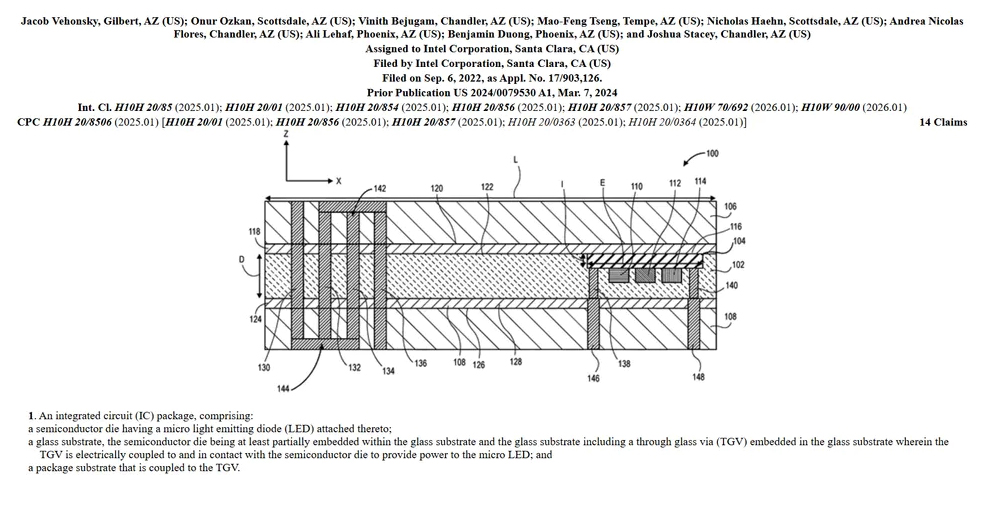
Intel's glass substrate packaging concept embeds MicroLED arrays within the chip package itself, powered via Through-Glass-Via connections.
Decoration or diagnostics?
The obvious consumer angle is cosmetic: MicroLEDs lighting up an Intel logo or model name on the chip package itself. But the patent actually emphasizes functional uses — status indicators showing which CPU operations are running, or system health signals readable without software. In data-center environments, that kind of at-a-glance hardware telemetry has real value.
It's worth being clear about what this isn't. The MicroLEDs in this design are not optical data interconnects — they don't carry data between components. The light is decorative or diagnostic, not a bandwidth play.
Intel is reportedly in talks with AU Optronics on advanced glass packaging collaboration, though the scope of that deal hasn't been publicly confirmed. Meanwhile, Samsung Electro-Mechanics and LG Innotek are both targeting mass production of their own glass substrates after 2027 — meaning Intel's head start in the technology could face competition sooner than expected.
What comes next
No Intel processor with MicroLED packaging has a confirmed launch date. Glass substrates themselves are still pre-mass-production across the industry — Samsung and LG both eye 2027–2028 for volume ramp-up. The advanced semiconductor packaging market is growing fast regardless: Global Market Insights projects it reaching $62 billion by 2031, up from $37.4 billion in 2026.
For now, this is Intel staking a claim on where chip packaging goes next — a future where your CPU might literally light up, whether to look good or to tell a data-center engineer something's wrong.


