Fujifilm's 40TB tape cartridge ships now — and 100TB with compression

Fujifilm's new LTO-10 Ultrium 40TB tape cartridge started shipping in January 2026, offering enterprises a single cartridge that holds up to 100TB of compressed data — enough for roughly 13 million MP3 tracks. Tape shipments jumped 57% year-on-year in Q1 2026, per StorageReview, driven largely by hyperscalers and media companies needing cheap, durable homes for AI training datasets.
The cartridge
The 40TB figure is native, uncompressed capacity. Apply the standard 2.5:1 compression ratio and you reach 100TB on a single cartridge the size of a paperback book. Fujifilm got there by combining barium ferrite magnetic particles with a new aramid-fiber substrate — a material borrowed from bulletproof vests — which lets the tape run about 30% longer than the 30TB variant released in mid-2025 without changing the cartridge shell. The drive packs 15,105 individual tracks onto that tape.
Transfer speed hits 440 MB/s native and up to 1,100 MB/s compressed, roughly double what a typical enterprise SATA hard drive can manage. The previous generation, LTO-9 from 2021, topped out at 400 MB/s with an 18TB native ceiling.
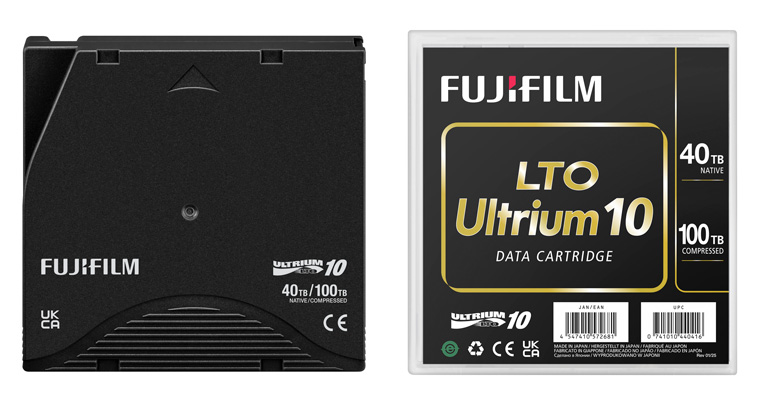
Fujifilm LTO-10 Ultrium 40TB tape cartridge — 15,105 tracks on an aramid-fiber substrate deliver 40TB native capacity.
Built for cold archives, not your desk
Tape's real selling point has always been longevity and cost per terabyte, not speed. Fujifilm claims a 30-year storage life and a bit error rate of 1 in 10²⁰ — about 100,000 times more reliable than a spinning hard drive. The cartridge also supports AES-256 hardware encryption, FIPS 197 compliance, and physical air-gap isolation, which is increasingly attractive as ransomware attacks on backup infrastructure become routine.
None of that comes cheap at the system level. The cartridge itself is priced around $495–$890, but it's useless without a dedicated LTO-10 tape drive or library that costs upward of $10,000. As confirmed by Fujifilm's UK press release, LTO-10 drives are not backward-compatible with LTO-9 cartridges — the head design changed entirely — so any organization upgrading faces a full infrastructure swap, not a slot-in upgrade.
Who's buying
This is strictly a data-center product. Seagate's 30TB HAMR drives compete for active workloads, but tape dominates cold archiving on cost at scale. The 57% demand surge reflects a structural shift: companies training large AI models generate petabytes of data that need to live somewhere cheap and safe for years. Tape, for all its retro associations, remains the most economical answer at that scale.
Mid-market businesses are largely priced out. The drive cost alone, combined with the need for a compatible tape library, puts LTO-10 firmly in the hands of enterprise data centers, broadcast archives, and government repositories — for now.


