AI's HBM Hunger Is Making Ordinary RAM More Expensive Than TSMC's Most Advanced Chips

RAM prices have quietly crossed a strange threshold: a square millimeter of standard consumer memory now costs more than a square millimeter of the most advanced processor silicon on the planet. That inversion is being driven by AI's insatiable appetite for high-bandwidth memory — and it's already hitting your next PC build.
The numbers
According to data from Kernel Insight, a 300mm wafer produced at TSMC's 2nm node costs roughly $30,000 — about 50% more than the previous 3nm generation. Break that down by die area and you get approximately $0.424 per mm². Meanwhile, per Sammy Fans, DRAM built on the latest 1b process node is fetching $0.654 per mm² — a 54% premium over TSMC's most expensive logic. Even older 1z-generation DRAM is trading at $0.410 per mm², nearly on par with 2nm wafers.
To be clear, this is a value-per-mm² comparison — what memory makers are earning on that silicon, not their raw production cost. But the gap still illustrates how dramatically the market has repriced memory.
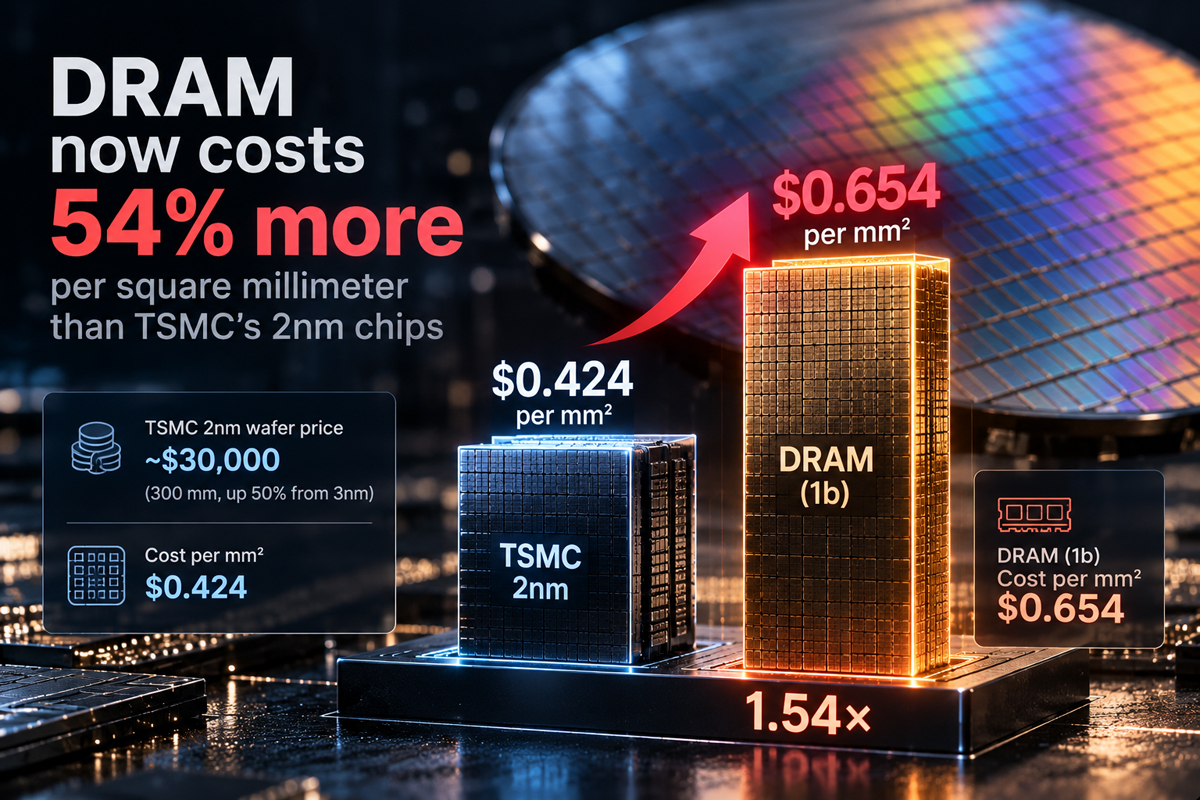
DRAM 1b-generation silicon now commands a higher price per mm² than TSMC's 2nm logic wafers — a direct consequence of AI-driven demand for high-bandwidth memory.
Why RAM suddenly costs this much
The short answer is HBM — high-bandwidth memory used in AI accelerators like Nvidia's H100 and B200. Producing a single HBM wafer displaces capacity that would otherwise yield three standard DDR5 wafers, reports Tom's Hardware. Samsung, SK Hynix, and Micron have all shifted significant fab capacity toward HBM to meet data-center demand, squeezing consumer supply hard.
DDR5 contract prices surged 90–95% in Q1 2026 alone. Samsung's average DDR5 selling price jumped 146% year-on-year by early 2026. Dell and HP have passed 20–50% increases onto retail buyers — Dell's COO described it as the fastest memory price rise he'd ever witnessed. Framework was forced to raise DDR5 upgrade pricing by 50%. Even US cloud giants like AWS, Azure, and Google Cloud absorbed 50% DRAM price hikes in late 2025 while accepting partial order fulfillment.
This shift is structural, not a blip. Samsung is Samsung is outsourcing DDR5 to focus on AI memory to third-party fabs so it can prioritize HBM — a move that signals the diversion of capacity isn't going anywhere soon. Meanwhile, TSMC's record revenue reflects just how much the AI build-out is reshaping the entire semiconductor supply chain.
What to expect
Analysts don't see meaningful relief before 2027. If you're upgrading a desktop or laptop in the near term, budget for DDR5 pricing that would have seemed absurd two years ago. The days of RAM being the cheapest item in a PC build are gone — at least for now.


